
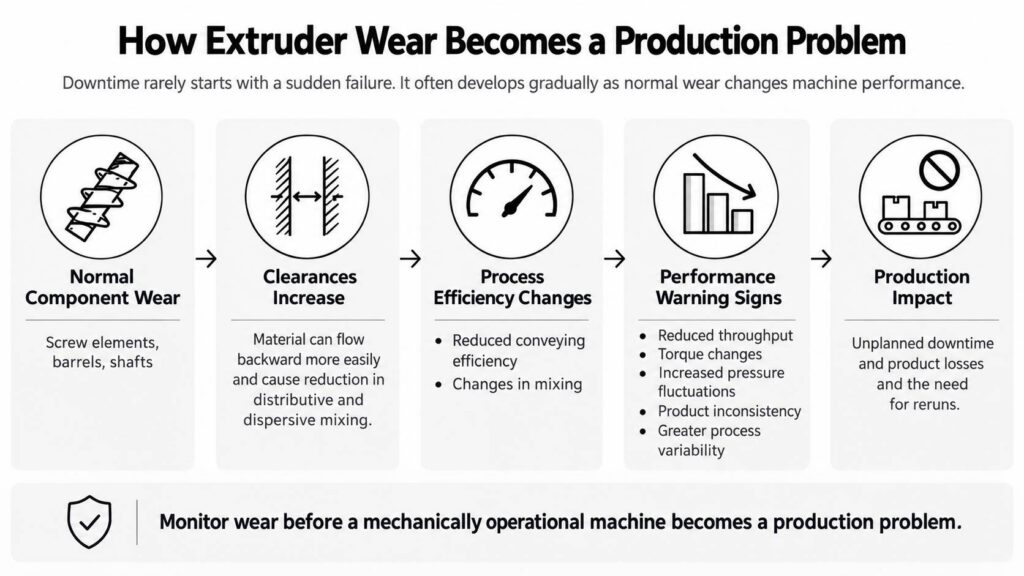
Downtime in a compounding extruder operation rarely starts with a sudden component failure. More often, processors notice gradual changes in throughput, torque, melt pressure or product quality. A process that once ran consistently may become harder to control as normal wear changes machine performance.
In a twin screw extruder, screw elements, barrels, shafts and other components operate under continuous torque, pressure, temperature and shear. Abrasive fillers, corrosive materials and demanding process conditions can accelerate wear.
The goal isn’t to eliminate wear. It is to understand it, monitor it and have the right extruder spare parts available before wear becomes unplanned downtime.
Understanding Compounding Extruders in Real Production Environments
A compounding extruder can continuously perform conveying, melting, mixing, side feeding, devolatilisation, reaction and pressure generation, depending on the screw configuration and application.
This flexibility makes co-rotating twin screw extruders useful across polymer compounding, powder coatings, adhesives and sealants, food processing and specialty chemical applications.
The demands on the machine can vary significantly from one section to another. A barrel section receiving abrasive filler may experience different wear from an upstream conveying section, while restrictive mixing elements can create areas of higher pressure, shear and mechanical loading.
For this reason, Xtrutech evaluates worn components in relation to the process around them. Material being processed, screw configuration, operating torque, screw speed, throughput and formulation changes can all help explain where and why wear occurs.
The Critical Role of Twin Screw Extruder Screw Elements
The screw configuration determines how material is conveyed and mixed through a twin screw extruder. Conveying elements move material forward, while kneading and mixing elements provide different levels of distributive and dispersive mixing. Restrictive or reverse elements can increase barrel fill, residence time and mixing intensity.
Pitch, stagger angle, element length and sequence also influence processing conditions.
As formulations change through higher filler loading, recycled content, abrasive pigments or reinforcing materials, an existing screw configuration may no longer provide the desired performance.
Worn or incorrectly specified twin screw extruder screw elements can contribute to:
- Torque instability
- Reduced conveying or pumping efficiency
- Reduced mixing performance
- Changes in residence time
- Higher specific energy consumption
- Product inconsistency
- Accelerated wear of surrounding components
Replacing worn elements is therefore an opportunity to ask whether the replacement is correctly manufactured and whether the existing screw configuration remains appropriate for the process.
What Happens as Extruder Screws and Barrels Wear?
Twin screw extrusion depends on controlled clearances between the screws and barrel. As screw elements and barrels wear, these clearances increase. Material can leak and flow backward more easily, reducing conveying and pumping efficiency while changing the mixing environment.
Operators may notice:
- Reduced throughput
- Changes in torque or specific energy
- Reduced pressure generation
- Less consistent conveying
- Changes in melt temperature
- Reduced product homogeneity
- Greater process variability
The machine may still be mechanically operational while losing process efficiency. Waiting for a component to fail completely can therefore result in unnecessary downtime and production losses.
Common Wear Mechanisms in Twin Screw Extrusion
Understanding the type of wear affecting an extruder helps determine the appropriate replacement screw elements, barrels and other extruder spare parts.
Abrasive Wear
Abrasive wear is common when processing formulations containing pigments, calcium carbonate, titanium dioxide, glass fibre and other mineral or reinforcing fillers. Wear can be concentrated around material introduction points and intensive mixing sections.
Adhesive Wear and Galling
High mechanical loading, unsuitable material combinations or insufficient clearances can cause metal-to-metal contact and galling. This can result in localised damage to screw elements, shafts and barrel components.
Corrosive Wear
Some polymers, additives and specialty chemical formulations create corrosive environments. In these applications, metallurgy must be selected for the chemical conditions as well as mechanical wear resistance.
Combined Wear
Multiple wear mechanisms can occur at the same time. A highly abrasive formulation running at elevated temperature, for example, may place simultaneous demands on mechanical and corrosion resistance.
The appropriate metallurgy, heat treatment and coatings should therefore be selected according to the actual application rather than simply choosing the hardest available material.
Matching Extruder Components to the Application
Material formulation, filler loading, processing temperature, screw speed and throughput all affect component performance and service life.
A component suitable for a low-abrasion polymer may not provide the same service life when processing glass-filled or mineral-filled compounds. Reviewing the application and previous wear patterns can help identify more suitable materials, coatings or component designs.
This application-based approach can help reduce premature wear and avoid repeating the same component failure.
Don’t Overlook Extruder Barrel Wear
Screw wear often receives more attention because the screw assembly is removed during maintenance. However, barrel condition is equally important.
Installing new screw elements into a significantly worn barrel does not restore the original operating clearances. Excessive barrel wear can continue to cause material leakage and reduced pumping efficiency, while mismatched wear conditions may accelerate deterioration of new components.
For this reason, extruder screws and barrels should be evaluated together.
Where practical, measuring and recording wear during planned maintenance can help establish trends and determine when components should be replaced.
Process Data Can Provide an Early Warning of Extruder Wear
Changes in machine performance do not always come from worn components. Raw material variation, feeding accuracy and process conditions can also affect extrusion.
Historical operating data can help separate these factors. For repeat products, monitoring torque, screw speed, throughput, melt pressure, temperature and specific energy consumption can reveal changes in machine behavior.
If the same formulation previously achieved a required throughput at a particular screw speed and torque but now requires different settings or operates within a narrower process window, the cause should be investigated.
Screw and barrel condition should be part of that investigation.
Twin Screw Extruder Venting and Devolatilization Problems
Venting problems can also involve both process and mechanical conditions.
Screw configuration, barrel fill, throughput, material viscosity and upstream pressure all influence how effectively a devolatilisation section operates. Increasing vacuum alone may not resolve a condition where the vent section is becoming overfilled.
Effective twin screw extruder troubleshooting therefore requires consideration of the process, screw configuration and mechanical condition together.
Developing an Effective Extruder Spare Parts Strategy
An effective extruder spare parts strategy does not require keeping every possible component in inventory. Instead, processors should identify the parts most critical to production and maintain them before they are needed.
Key considerations include:
- Which screw elements experience the highest wear?
- Which barrel sections operate under the most severe conditions?
- Which extruder spare parts have long replacement lead times?
- Which components could stop production if they failed?
- Can worn parts be identified during planned shutdowns?
- Are sufficient elements available to rebuild critical screw sections?
- Are shafts, seals and other critical components included?
Recording component conditions during maintenance can make this strategy more effective. Once wear rates are understood, maintenance can become more predictive and less reactive.
Replacement Extruder Parts Don’t Always Need to Be Like-for-Like
Xtrutech manufactures extruder spare parts and replacement wear components for a wide range of twin screw extruder platforms.
A replacement component does not always need to duplicate the original specification. Where appropriate, Xtrutech can consider the existing component, processing conditions and wear pattern to determine whether changes in material, heat treatment, coating or geometry may provide an advantage.
This is particularly relevant when the process has changed. Higher filler loadings, increased recycled content, different raw materials or greater throughput can place different demands on equipment than those present when the extruder was originally specified.
Replacement Screw Elements, Barrels and Shafts for Multiple Extruder Platforms
Production facilities often operate twin screw extruders from multiple manufacturers, including older equipment. Managing separate sources of extruder spare parts can add complexity, particularly when OEM components have extended lead times.
Xtrutech supplies replacement screw elements, extruder shafts, barrels and associated wear parts for a wide range of OEM twin screw extruder platforms.
Components can be manufactured from drawings, samples or existing machine information, with dimensional inspection, material selection and the intended processing environment considered during the engineering process.
Reducing Compounding Extruder Downtime Through Better Maintenance
Every compounding extruder experiences wear. The objective is to manage that wear before it becomes a production problem.
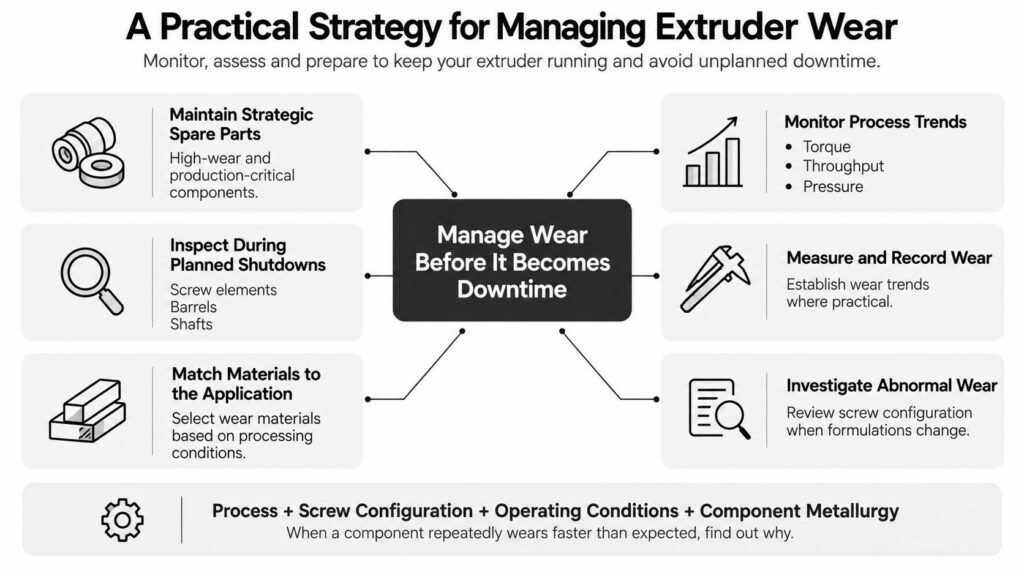
A practical maintenance strategy includes:
- Maintaining strategic inventory of high-wear extruder spare parts
- Monitoring torque, throughput and pressure trends
- Inspecting screw elements, barrels and shafts during planned shutdowns
- Measuring and recording wear where practical
- Selecting wear materials based on the application
- Reviewing screw configurations when formulations change
- Investigating abnormal or accelerated wear
When an extruder component repeatedly wears faster than expected, don’t just replace it.
Find Out Why
Understanding the relationship between the process, screw configuration, operating conditions and component metallurgy can provide more value than another like-for-like replacement.
Extruder Spare Parts and Process Support from Xtrutech
Xtrutech supports processors across polymer compounding, powder coatings, adhesives and sealants, food processing and specialty chemical applications. The company supplies replacement screw elements, extruder barrels, shafts and other wear components for Xtrutech equipment and other OEM twin screw extruder platforms.
If you’re experiencing accelerated wear, declining extruder performance, extended spare parts lead times or recurring downtime, contact Xtrutech to discuss your compounding extruder, twin screw extruder spare parts or wear component requirements.